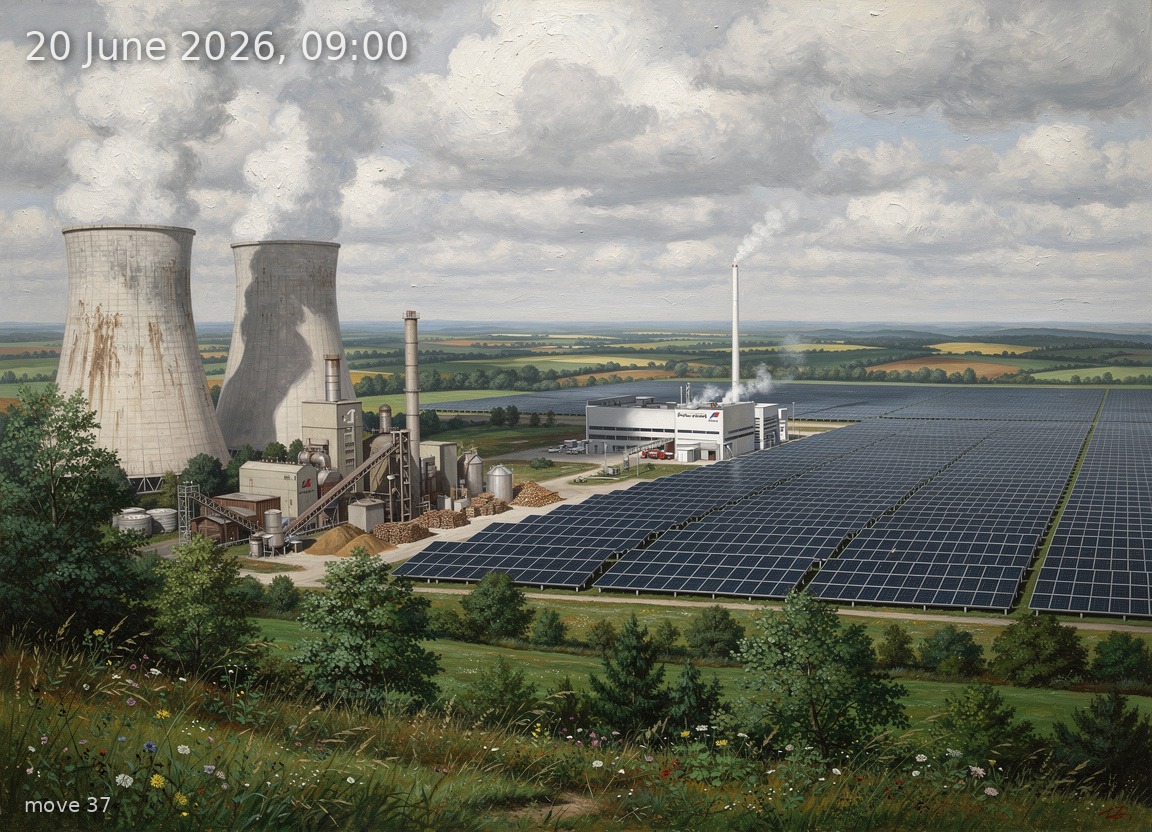
Diffuse solar at 30.7 GW leads generation under full overcast, with brown coal and biomass providing steady baseload support.
Back
Generation mix
Wind onshore 7%
Wind offshore 3%
Solar 64%
Biomass 8%
Hydro 4%
Natural gas 4%
Hard coal 1%
Brown coal 8%
86%
Renewable share
5.0 GW
Wind (on + offshore)
30.7 GW
Solar
47.9 GW
Total generation
-2.2 GW
Net import
41.3 €/MWh
Day-ahead price
21.6°C / 12 km/h
Temp / Wind speed
Open-Meteo, Kassel (51.3°N 9.5°E)
100.0% / 34.0 W/m²
Cloud cover / Radiation
96
gCO₂/kWh
Image prompt
Solar 30.7 GW dominates the scene as vast fields of aluminium-framed crystalline silicon PV panels stretching across more than half the canvas from the centre to the right, their dark blue surfaces reflecting a pale, milky overcast sky. Brown coal 4.0 GW occupies the left foreground as two massive hyperbolic concrete cooling towers with thick white-grey steam plumes merging into the low cloud ceiling. Biomass 4.0 GW appears just right of the cooling towers as a cluster of wood-chip-fed industrial boiler plants with tall rectangular stacks and conveyor belts, proportional in visual area to the brown coal. Natural gas 2.0 GW is rendered as a single compact CCGT unit with a slender exhaust stack and modest heat shimmer, tucked between the biomass plant and the solar fields. Hydro 1.8 GW appears in the mid-ground as a concrete run-of-river weir with churning white water spilling over. Wind onshore 3.4 GW is shown as a small cluster of three-blade turbines on a gentle hill in the right background, rotors turning slowly in light wind. Wind offshore 1.6 GW is suggested by a faint line of turbines on a distant grey horizon beyond the solar fields. Hard coal 0.5 GW is a single small smokestack with a thin wisp of exhaust at the far left edge. The lighting is full mid-morning daytime but entirely diffuse: no shadows, no direct sun, a uniform bright grey-white cloud deck at 100% coverage stretching horizon to horizon. The landscape is lush central German summer — green deciduous trees, tall grass, wildflowers at 21.6 °C — but the atmosphere is flat and muted, neither oppressive nor dramatic, reflecting the moderate 41.3 EUR/MWh price. Painted as a highly detailed oil painting in the tradition of 19th-century German Romantic landscape masters such as Caspar David Friedrich and Carl Blechen: rich layered colour despite the overcast palette, visible impasto brushwork in the clouds and steam plumes, atmospheric aerial perspective fading the distant offshore turbines into haze, meticulous engineering accuracy in every nacelle, panel frame, and cooling tower curve. No text, no labels.