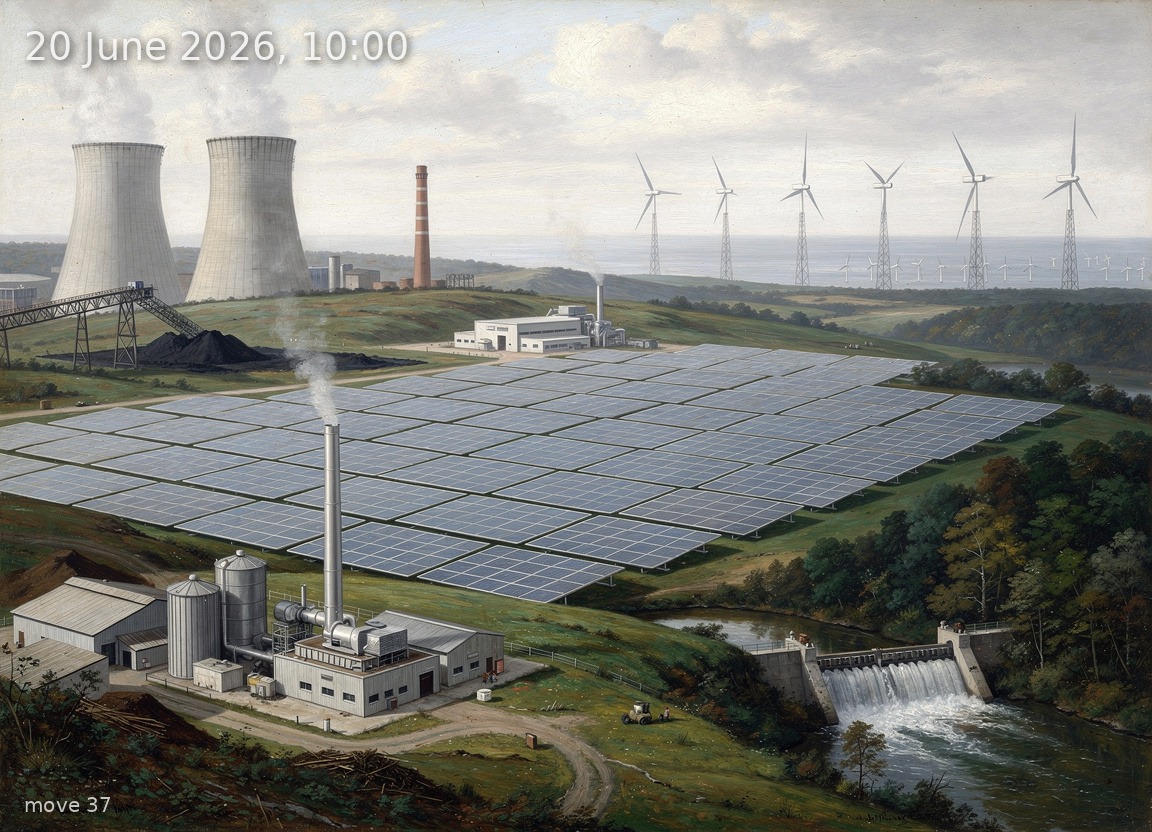
Solar at 38.6 GW drives 90% renewables and near-zero pricing under full overcast on a mild June morning.
Back
Generation mix
Wind onshore 5%
Wind offshore 3%
Solar 72%
Biomass 7%
Hydro 3%
Natural gas 3%
Hard coal 1%
Brown coal 6%
90%
Renewable share
4.3 GW
Wind (on + offshore)
38.6 GW
Solar
53.8 GW
Total generation
+2.8 GW
Net export
4.1 €/MWh
Day-ahead price
21.5°C / 11 km/h
Temp / Wind speed
Open-Meteo, Kassel (51.3°N 9.5°E)
100.0% / 28.0 W/m²
Cloud cover / Radiation
68
gCO₂/kWh
Image prompt
Solar 38.6 GW dominates the scene as an immense field of aluminium-framed crystalline silicon photovoltaic panels stretching across roughly 70% of the composition, covering gentle green rolling hills in the centre and right, their blue-grey surfaces reflecting the diffuse white light of a fully overcast sky. Brown coal 3.1 GW appears at the far left as two hyperbolic concrete cooling towers with thin white steam plumes rising into the flat cloud layer, beside a conveyor belt carrying dark lignite. Biomass 3.9 GW sits in the left-centre as a cluster of modest industrial buildings with cylindrical wood-chip silos and a single low smokestack emitting faint grey vapour. Wind onshore 2.8 GW shows as five three-blade turbines on lattice towers scattered along a distant ridgeline, their rotors turning slowly in the light 11 km/h breeze. Wind offshore 1.5 GW is suggested by a row of smaller turbines visible on the far horizon above a sliver of grey North Sea. Hydro 1.8 GW appears as a small concrete run-of-river weir with white water spilling over, tucked into a wooded valley at the right edge. Natural gas 1.6 GW is a compact CCGT plant with a single tall exhaust stack and small heat-recovery unit, positioned behind the solar field at left-centre. Hard coal 0.4 GW is a barely visible older brick smokestack behind the brown coal towers, almost lost in the haze. The lighting is full mid-morning daylight at 10:00 in June but entirely diffuse — no shadows, no direct sun, a uniformly white-grey sky ceiling pressing down softly. The temperature is a pleasant 21.5°C; lush green deciduous trees in full summer leaf frame the edges, wildflowers dot the meadows between panel rows. The atmosphere is calm and open, reflecting the very low electricity price. Painted in the style of a highly detailed 19th-century German Romantic oil painting — rich colour palette, visible impasto brushwork, atmospheric aerial perspective fading into misty distance — yet every piece of energy infrastructure is rendered with meticulous engineering accuracy: turbine nacelles, panel wiring, cooling tower fluting, CCGT exhaust geometry. No text, no labels.