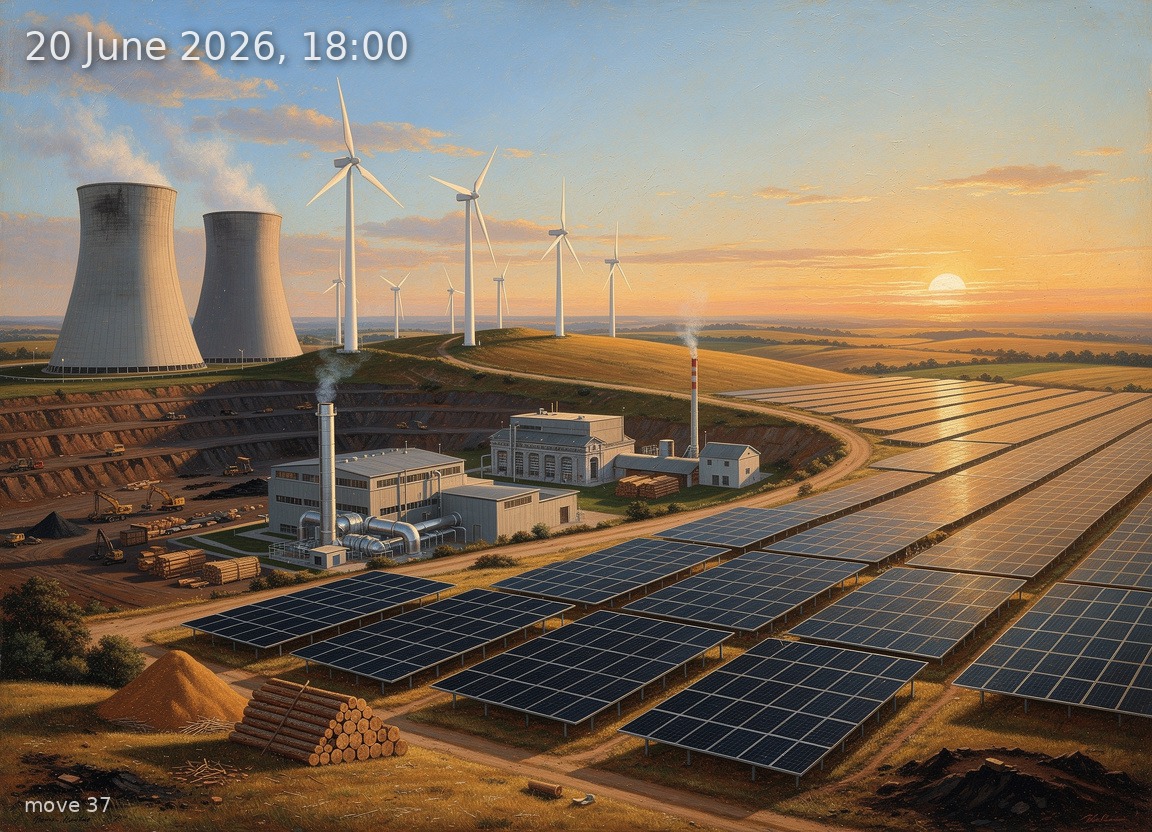
Solar leads at 17.2 GW but 11.6 GW net imports are needed as hot-weather demand reaches 48 GW.
Back
Generation mix
Wind onshore 15%
Wind offshore 3%
Solar 47%
Biomass 10%
Hydro 5%
Natural gas 6%
Hard coal 4%
Brown coal 10%
80%
Renewable share
6.5 GW
Wind (on + offshore)
17.2 GW
Solar
36.4 GW
Total generation
-11.6 GW
Net import
119.8 €/MWh
Day-ahead price
32.1°C / 6 km/h
Temp / Wind speed
Open-Meteo, Kassel (51.3°N 9.5°E)
4.0% / 409.0 W/m²
Cloud cover / Radiation
139
gCO₂/kWh
Image prompt
Solar 17.2 GW dominates the right half and centre of the scene as vast fields of aluminium-framed crystalline silicon photovoltaic panels stretching across golden-dry summer farmland, their surfaces angled toward a sun still well above the western horizon. Wind onshore 5.4 GW appears as a line of tall three-blade turbines with white tubular towers on a gentle ridge in the centre-left, their rotors barely turning in the faint breeze. Brown coal 3.6 GW occupies the far left as two large hyperbolic cooling towers with lazy white steam plumes rising into still air beside a lignite open-pit mine. Biomass 3.7 GW is rendered as a compact wood-chip power station with a modest smokestack and timber storage yard just behind the cooling towers. Natural gas 2.1 GW appears as a small modern CCGT plant with a single tall exhaust stack and slim heat-recovery unit in the centre-left middle ground. Hard coal 1.4 GW is a smaller classical power station with a single squat cooling tower beside a coal conveyor, tucked behind the gas plant. Hydro 1.9 GW shows as a concrete dam with spillway visible in a river valley in the distant left background. Wind offshore 1.1 GW appears as a tiny cluster of turbines on the far horizon line. The lighting is late-afternoon dusk transition at 18:00 in June: the sun is low but still above the horizon, casting long warm golden-orange light across the landscape, with the sky overhead still bright blue fading to amber and peach near the horizon, only 4% cloud cover — almost entirely clear. The atmosphere feels heavy and oppressive from extreme 32°C heat: shimmering heat haze distorts the middle distance, dry parched grass and wilting vegetation suggest a heatwave, and the air has a thick, molten quality reflecting the high electricity price. Painted in the style of a highly detailed 19th-century German Romantic oil painting — rich saturated colour, visible textured brushwork, dramatic atmospheric depth with careful aerial perspective — yet every piece of energy infrastructure is rendered with meticulous engineering accuracy: turbine nacelles with three-blade rotors, PV panel grid patterns, cooling tower parabolic profiles with condensation plumes, gas turbine exhaust details. No text, no labels.