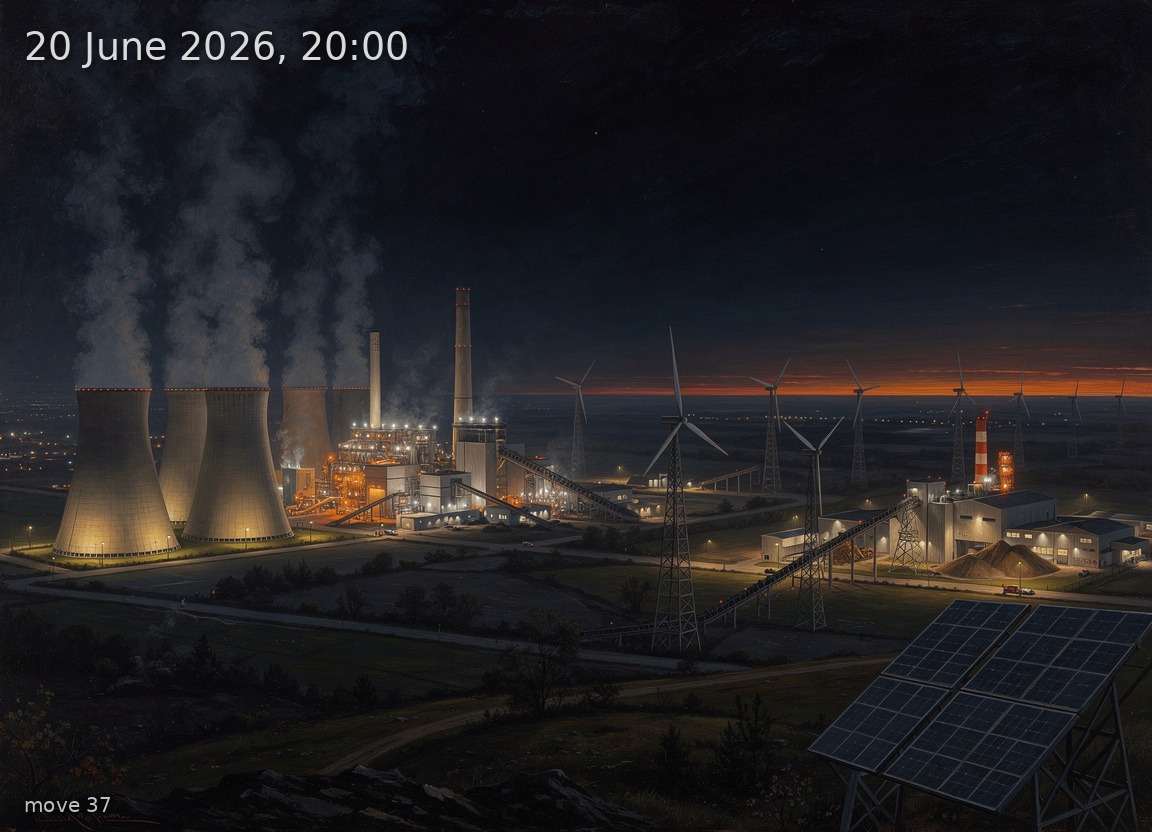
Brown coal, gas, and wind lead generation as heavy imports cover a 19 GW gap on a hot evening.
Back
Generation mix
Wind onshore 18%
Wind offshore 2%
Solar 9%
Biomass 14%
Hydro 6%
Natural gas 19%
Hard coal 10%
Brown coal 21%
50%
Renewable share
5.8 GW
Wind (on + offshore)
2.7 GW
Solar
28.6 GW
Total generation
-19.0 GW
Net import
172.0 €/MWh
Day-ahead price
30.4°C / 8 km/h
Temp / Wind speed
Open-Meteo, Kassel (51.3°N 9.5°E)
0.0% / 141.0 W/m²
Cloud cover / Radiation
340
gCO₂/kWh
Image prompt
Brown coal 5.9 GW dominates the left quarter as a cluster of massive hyperbolic cooling towers with thick white steam plumes rising into a dark navy-blue night sky; natural gas 5.5 GW fills the centre-left as compact CCGT power blocks with tall single exhaust stacks emitting thin heat shimmer, lit by sodium-orange industrial floodlights; onshore wind 5.2 GW occupies the centre-right as a line of tall three-blade turbines on lattice towers, their rotors barely turning in light wind, silhouetted against the deep dark sky; biomass 4.0 GW appears as a mid-sized industrial plant with a wood-chip conveyor and modest chimney glowing warmly in the right-centre background; hard coal 2.8 GW sits as a coal-fired station with conveyor belts and a single large stack behind the gas plant on the left; solar 2.7 GW is rendered as a field of aluminium-framed crystalline silicon panels in the right foreground catching the very last amber traces of post-sunset horizon glow, mostly dark and reflective; hydro 1.8 GW appears as a concrete dam spillway in the far right distance with white water cascading; offshore wind 0.7 GW is a faint cluster of turbines on the distant horizon line. The sky is completely dark above — deep black-navy, no twilight, no sky glow — with only a razor-thin burnt-orange line at the western horizon marking where the sun has already set. The air feels oppressively hot and heavy, with a haze hanging over the industrial landscape suggesting 30°C heat even at night. Vegetation is lush midsummer green but wilted and parched. All facilities are lit by harsh sodium-yellow and white industrial lighting, casting long shadows. Power lines with steel lattice pylons stretch across the scene carrying heavy loads. The atmosphere is dense and brooding, suggesting expensive electricity and strained supply. Rendered as a highly detailed oil painting in the tradition of 19th-century German Romantic landscape painters — rich saturated colour, visible impasto brushwork, dramatic chiaroscuro between artificial light and deep darkness, atmospheric depth with industrial haze — but with meticulous engineering accuracy on every turbine nacelle, cooling tower, PV module frame, and exhaust stack. No text, no labels.