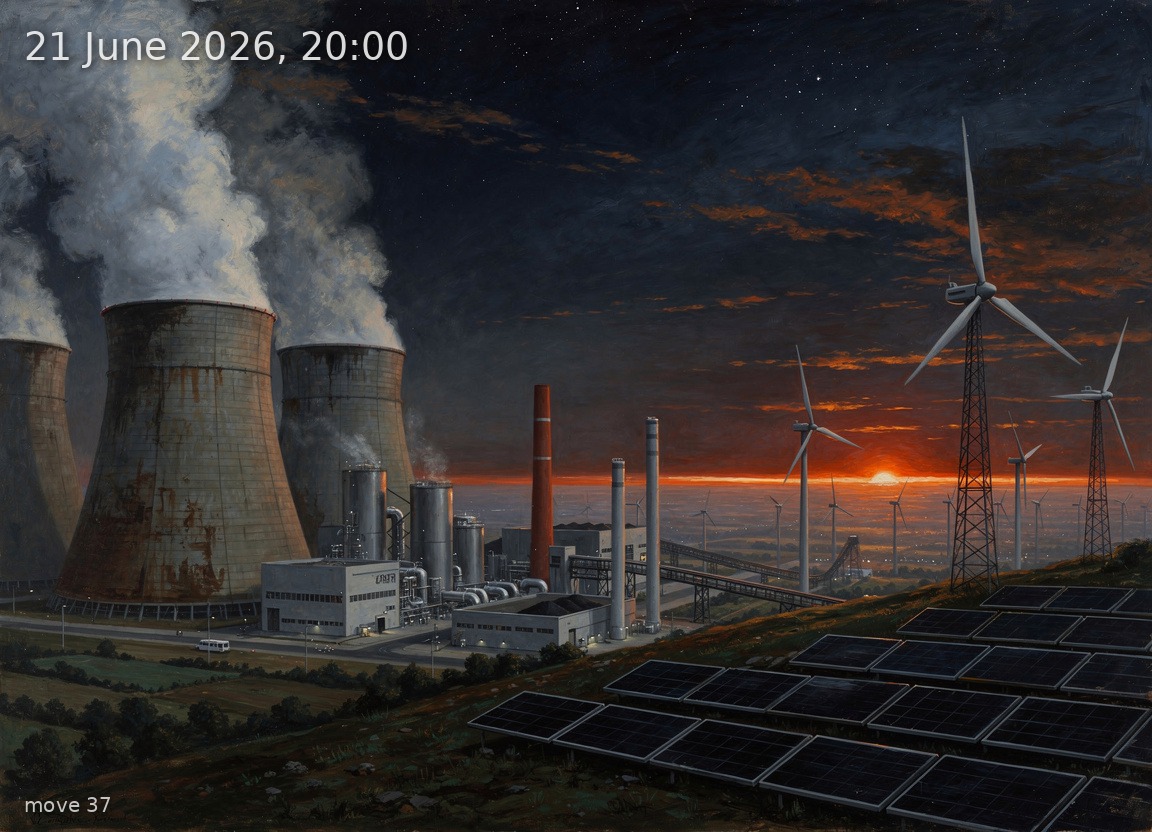
Brown coal and gas lead evening dispatch as solar fades, with 18.2 GW net imports bridging the consumption gap.
Back
Generation mix
Wind onshore 19%
Wind offshore 6%
Solar 9%
Biomass 13%
Hydro 6%
Natural gas 17%
Hard coal 9%
Brown coal 23%
52%
Renewable share
7.4 GW
Wind (on + offshore)
2.6 GW
Solar
30.3 GW
Total generation
-18.2 GW
Net import
150.0 €/MWh
Day-ahead price
27.8°C / 10 km/h
Temp / Wind speed
Open-Meteo, Kassel (51.3°N 9.5°E)
23.0% / 129.0 W/m²
Cloud cover / Radiation
331
gCO₂/kWh
Image prompt
Brown coal 6.9 GW dominates the left third of the scene as a cluster of massive hyperbolic cooling towers with thick white-grey steam plumes rising into the darkening sky; natural gas 5.0 GW occupies the centre-left as a compact CCGT plant with tall slender exhaust stacks emitting thin heat shimmer; wind onshore 5.7 GW spreads across the right-centre as a line of three-blade turbines on lattice towers turning slowly on a gentle breeze; solar 2.6 GW appears in the lower centre-right as a modest field of aluminium-framed crystalline silicon panels catching the last dim amber light on their surfaces; biomass 4.0 GW is rendered centre-right as a wood-clad industrial facility with a moderate smokestack and warm interior glow from lit windows; hard coal 2.6 GW sits behind the brown coal as a smaller conventional power station with a single large chimney and conveyor belts; wind offshore 1.7 GW is suggested in the far-right distance as small turbines on a hazy horizon line above a faintly visible sea; hydro 1.8 GW appears in the lower right as a concrete dam structure with water cascading and warm sodium lights illuminating its face. The sky is a late summer solstice dusk at 20:00 in Germany — the sun has just set, leaving a narrow band of deep orange-red glow along the very lowest horizon, rapidly darkening upward into deep indigo and near-black overhead; a few stars begin to emerge. The atmosphere feels heavy, oppressive, and humid, reflecting the 150 EUR/MWh price — haze and industrial vapour thicken the air. Temperature is warm at 27.8°C: lush green deciduous trees in full summer leaf, tall grasses, warm tones throughout. Cloud cover is sparse at 23%, with a few thin clouds catching the last fading orange light. Sodium streetlights and industrial facility lights are beginning to glow throughout the scene. Highly detailed oil painting in the tradition of 19th-century German Romantic landscape painters — Caspar David Friedrich meets industrial sublime — rich impasto colour, visible expressive brushwork, atmospheric depth and chiaroscuro, meticulous engineering detail on all turbine nacelles, rotor blades, cooling tower geometries, PV panel frames, and plant structures. No text, no labels.