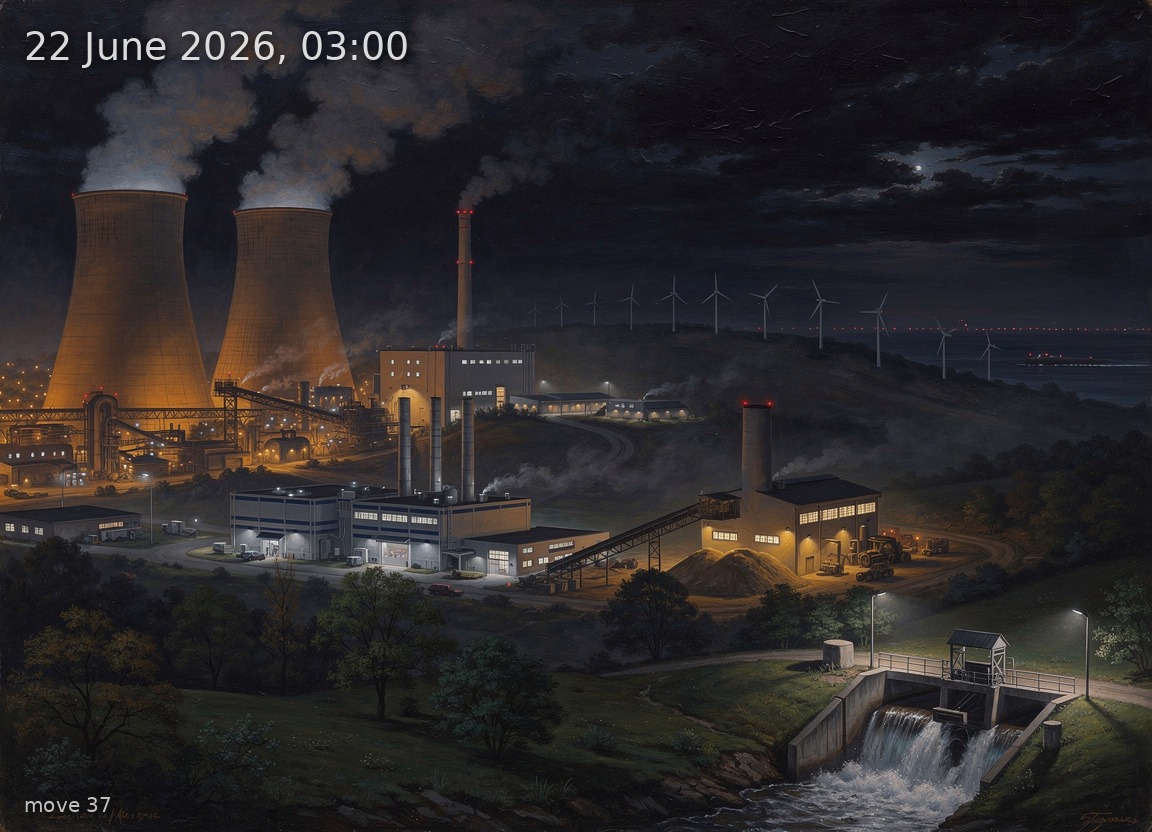
Brown coal and wind lead overnight generation as Germany imports roughly 11.4 GW to meet 40.5 GW demand.
Back
Generation mix
Wind onshore 22%
Wind offshore 7%
Biomass 12%
Hydro 6%
Natural gas 17%
Hard coal 10%
Brown coal 26%
47%
Renewable share
8.2 GW
Wind (on + offshore)
0.0 GW
Solar
29.1 GW
Total generation
-11.4 GW
Net import
115.2 €/MWh
Day-ahead price
18.6°C / 6 km/h
Temp / Wind speed
Open-Meteo, Kassel (51.3°N 9.5°E)
68.0% / 0.0 W/m²
Cloud cover / Radiation
374
gCO₂/kWh
Image prompt
Brown coal 7.7 GW dominates the left third of the scene as a sprawling lignite power complex with three massive hyperbolic cooling towers emitting thick steam plumes lit from below by orange sodium lights; wind onshore 6.3 GW occupies the centre-right as a long ridge of three-blade turbines on lattice towers, rotors turning slowly in light wind, their red aviation warning lights blinking against the black sky; natural gas 5.1 GW appears centre-left as two compact CCGT plants with slim exhaust stacks venting thin pale flue gas, illuminated by industrial floodlights; biomass 3.6 GW is rendered as a mid-sized wood-chip power station with a single squat smokestack and a conveyor belt feeding fuel, warm yellow light spilling from its facility windows; hard coal 2.8 GW sits beside the lignite complex as a smaller conventional power station with a rectangular boiler house and a single tall chimney; wind offshore 2.0 GW appears as a distant cluster of turbines on the far right horizon, tiny red lights hovering above a suggestion of dark sea; hydro 1.7 GW is a small dam and penstock structure in the lower right foreground, white water glinting under a single floodlight. The sky is completely dark, deep navy-black, no twilight, no glow on the horizon — it is 3 AM in midsummer; 68% cloud cover creates a thick overcast blotting out stars except for a few faint gaps. The atmosphere feels heavy and oppressive, reflecting the high electricity price — low haze hangs over the industrial structures, tinged amber by sodium street lighting. The landscape is gentle central German rolling hills, with lush green deciduous trees and grass visible only where artificial light reaches them, suggesting the mild 18.6°C summer night. No solar panels anywhere — no sunlight exists. Highly detailed oil painting in the tradition of 19th-century German Romantic landscape painting — rich, dark palette of indigo, amber, and charcoal with visible impasto brushwork, atmospheric depth through layered mist and smoke, meticulous engineering accuracy on every turbine nacelle, cooling tower, and exhaust stack. The composition evokes Caspar David Friedrich reimagined for the industrial age. No text, no labels.