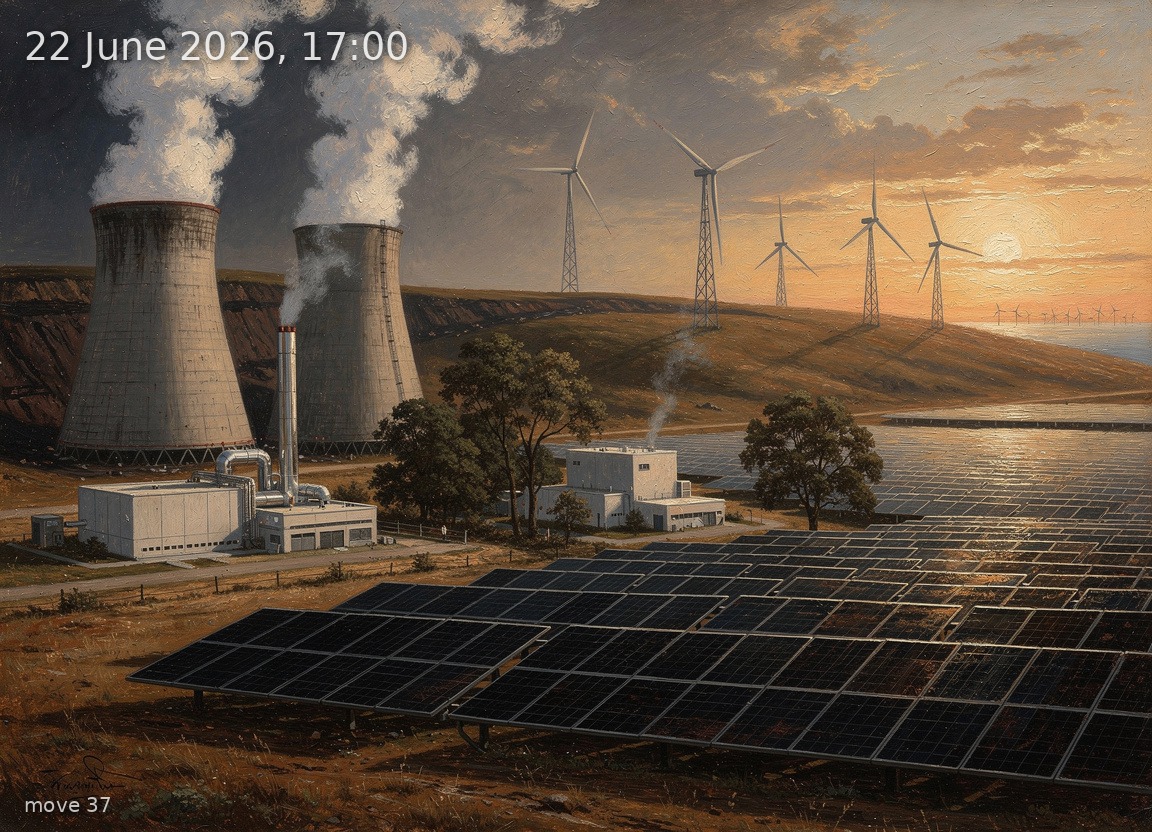
Solar leads at 28.6 GW with brown coal backup at 7.3 GW; 8.4 GW net imports cover heatwave demand.
Back
Generation mix
Wind onshore 9%
Wind offshore 2%
Solar 57%
Biomass 7%
Hydro 3%
Natural gas 4%
Hard coal 2%
Brown coal 15%
79%
Renewable share
5.6 GW
Wind (on + offshore)
28.6 GW
Solar
49.8 GW
Total generation
-8.4 GW
Net import
114.1 €/MWh
Day-ahead price
29.9°C / 10 km/h
Temp / Wind speed
Open-Meteo, Kassel (51.3°N 9.5°E)
0.0% / 372.0 W/m²
Cloud cover / Radiation
154
gCO₂/kWh
Image prompt
Solar 28.6 GW dominates the scene as vast expanses of crystalline silicon photovoltaic panels stretching across the right two-thirds of the composition, their aluminium frames gleaming in low amber-orange sunlight. Brown coal 7.3 GW occupies the left portion as massive hyperbolic cooling towers with thick white steam plumes rising against a darkening sky. Wind onshore 4.5 GW appears as a row of three-blade turbines with lattice towers on gentle hills behind the solar fields, their blades barely turning in light breeze. Wind offshore 1.1 GW is suggested as tiny distant turbines on a hazy horizon line. Biomass 3.6 GW is rendered as a modest biomass plant with a rectangular stack and thin grey exhaust plume nestled among trees at mid-ground. Natural gas 2.1 GW appears as a compact CCGT unit with a single polished exhaust stack and faint heat shimmer, positioned near the cooling towers. Hard coal 0.9 GW is a small conventional power station with a single smokestack barely visible behind the lignite plant. Hydro 1.7 GW is depicted as a stone-faced dam with water cascading in the far background valley. The sky is a dusk scene at 17:00 in late June: the sun hangs low in the west, casting a deep orange-red glow along the lower horizon while the upper sky transitions from warm amber to a deepening steel blue, creating an oppressive heavy atmosphere reflecting the high electricity price. The landscape is parched summer central Germany — dry golden grass, mature deciduous trees in full dark-green canopy wilting slightly in the 30 °C heat, shimmering heat haze above the solar panels. The air feels thick and weighty. Highly detailed oil painting in the tradition of 19th-century German Romantic landscape painters such as Caspar David Friedrich and Carl Blechen, with rich impasto brushwork, luminous atmospheric depth, dramatic chiaroscuro between the blazing sunset light on the panels and the shadowed industrial structures, meticulous engineering accuracy on all energy infrastructure. No text, no labels.