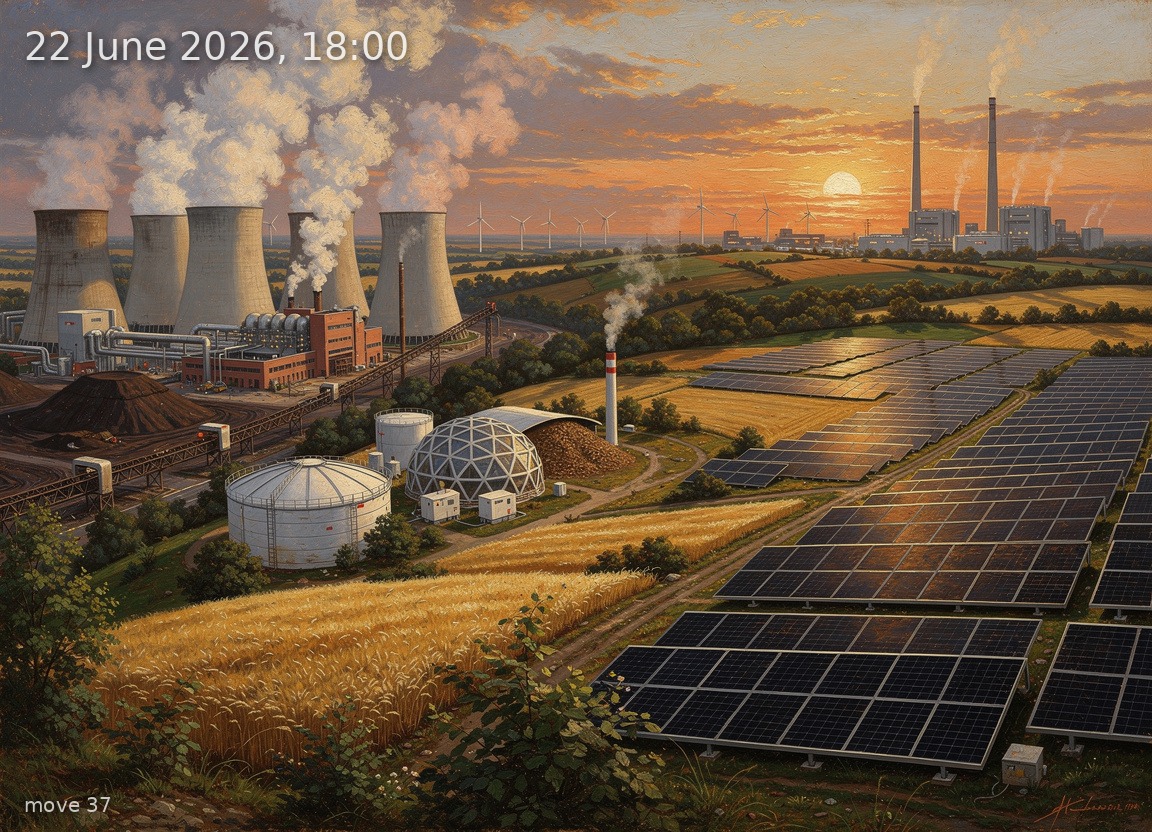
Solar leads at 18.4 GW but 17 GW net imports are needed as summer heat pushes consumption to 59.2 GW.
Back
Generation mix
Wind onshore 13%
Wind offshore 3%
Solar 44%
Biomass 9%
Hydro 4%
Natural gas 6%
Hard coal 3%
Brown coal 20%
72%
Renewable share
6.5 GW
Wind (on + offshore)
18.4 GW
Solar
42.2 GW
Total generation
-17.0 GW
Net import
145.6 €/MWh
Day-ahead price
29.6°C / 11 km/h
Temp / Wind speed
Open-Meteo, Kassel (51.3°N 9.5°E)
27.0% / 312.0 W/m²
Cloud cover / Radiation
212
gCO₂/kWh
Image prompt
Solar 18.4 GW dominates the right half of the canvas as vast fields of aluminium-framed crystalline silicon PV panels stretching across golden-stubble farmland, angled toward a still-bright but lowering sun; brown coal 8.3 GW occupies the left quarter as a cluster of massive hyperbolic concrete cooling towers emitting thick white steam plumes, with conveyor belts carrying dark lignite into a sprawling power station; wind onshore 5.3 GW appears as a line of eight modern three-blade turbines on lattice and tubular towers across a gentle ridge in the middle distance, their rotors turning slowly in light breeze; natural gas 2.5 GW is rendered as two compact CCGT units with tall single exhaust stacks venting thin heat shimmer, positioned near the coal complex; biomass 3.6 GW shows as a mid-sized plant with a domed biogas digester and a wood-chip storage dome beside a small smokestack; hydro 1.7 GW appears as a concrete run-of-river weir in a shallow valley with water spilling over; hard coal 1.2 GW is a smaller brick-built power station with a single square chimney beside a coal stockpile; wind offshore 1.2 GW is suggested by a distant row of four turbines barely visible on the far horizon. Time of day is dusk at 18:00 in late June Berlin: the sun sits roughly 20 degrees above the western horizon casting long amber-orange light, the upper sky transitions from pale warm blue to deeper blue overhead, scattered cumulus clouds (27% cover) are lit orange and pink from below. The atmosphere feels oppressive and heavy — haze shimmers above the fields, 29.6°C summer heat visible in parched grass, wilting linden trees, and heat distortion above dark rooftops. Lush but stressed deciduous vegetation, ripe wheat fields. Style: highly detailed oil painting in the tradition of 19th-century German Romantic landscape painters such as Caspar David Friedrich and Carl Blechen, with rich saturated color, visible thick brushwork, atmospheric aerial perspective, dramatic chiaroscuro where industrial steam catches golden light against a deepening sky. Meticulous engineering accuracy on all infrastructure. No text, no labels.