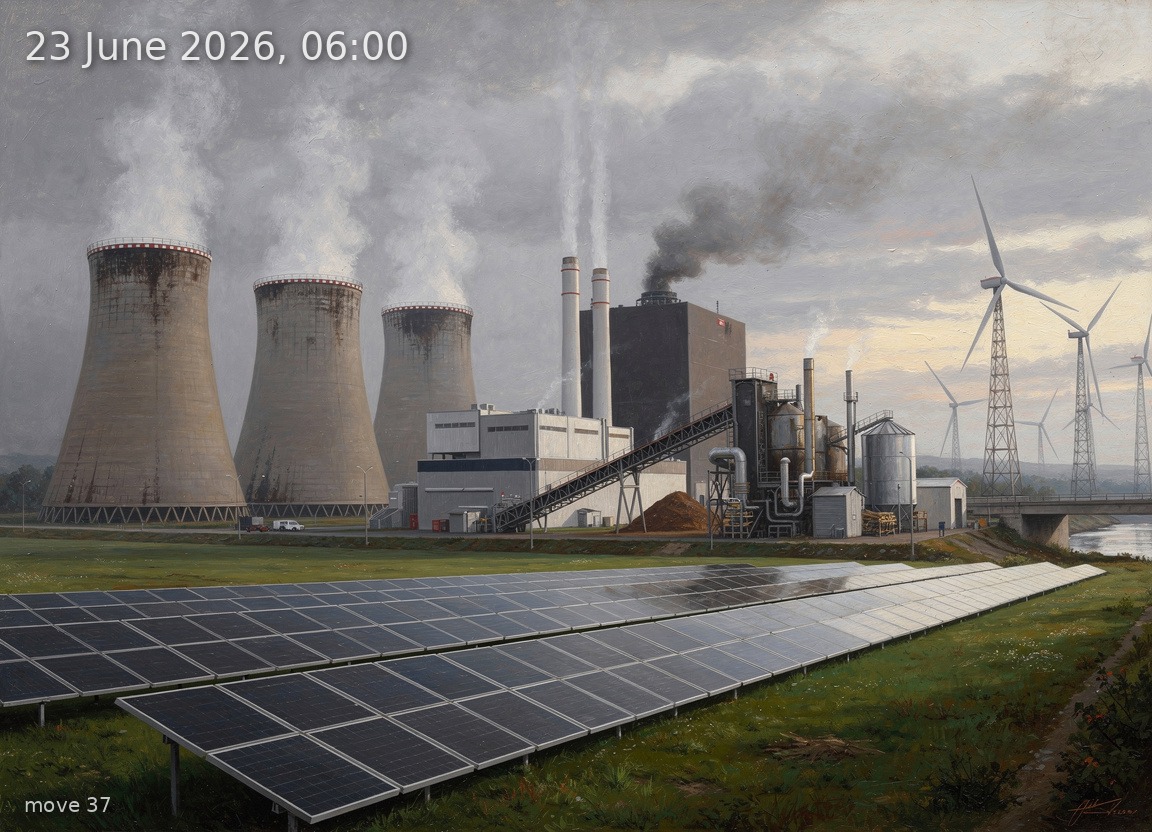
Brown coal and gas dominate as overcast skies and calm winds force heavy imports to meet 53.5 GW demand.
Back
Generation mix
Wind onshore 7%
Wind offshore 1%
Solar 16%
Biomass 13%
Hydro 6%
Natural gas 20%
Hard coal 10%
Brown coal 29%
42%
Renewable share
2.3 GW
Wind (on + offshore)
4.8 GW
Solar
30.2 GW
Total generation
-23.2 GW
Net import
164.2 €/MWh
Day-ahead price
18.1°C / 6 km/h
Temp / Wind speed
Open-Meteo, Kassel (51.3°N 9.5°E)
100.0% / 0.0 W/m²
Cloud cover / Radiation
406
gCO₂/kWh
Image prompt
Brown coal 8.6 GW dominates the left third of the scene as four massive hyperbolic cooling towers with thick white-grey steam plumes rising into the overcast sky; natural gas 5.9 GW occupies the centre-left as two compact CCGT plant blocks with tall single exhaust stacks and thinner vapour trails; solar 4.8 GW appears in the centre as a broad field of aluminium-framed crystalline silicon PV panels on green summer grass, their surfaces dull and reflecting only grey sky with no direct sunlight; biomass 3.8 GW is rendered centre-right as a cluster of industrial wood-chip combustion facilities with modest chimneys and small steam wisps; hard coal 3.0 GW sits behind the biomass as a coal-fired plant with a single large stack and conveyor belt visible; wind onshore 2.1 GW appears in the right background as a sparse row of three-blade turbines on lattice towers, their rotors turning very slowly in near-still air; hydro 1.8 GW is suggested at the far right by a concrete run-of-river dam with water spilling over a weir; wind offshore 0.3 GW is barely visible as tiny turbine silhouettes on the far horizon. The sky is entirely blanketed in heavy, low, oppressive stratus clouds with no break—100% overcast. The lighting is pre-dawn at 06:00 in late June: a pale blue-grey diffuse glow suffusing the eastern horizon, no direct sunlight, the landscape still mostly in cool shadow with the first weak light catching the tops of the cooling towers and turbine nacelles. The atmosphere feels heavy and pressured, conveying the high electricity price. Lush green deciduous trees and meadows reflect an 18°C June morning. Painted as a highly detailed oil painting in the tradition of 19th-century German Romantic landscape painters—Caspar David Friedrich meets industrial sublime—with rich tonal depth, visible impasto brushwork, atmospheric perspective receding into misty grey distance, meticulous engineering detail on every technology, and dramatic chiaroscuro between the pale dawn sky and the dark industrial silhouettes. No text, no labels.